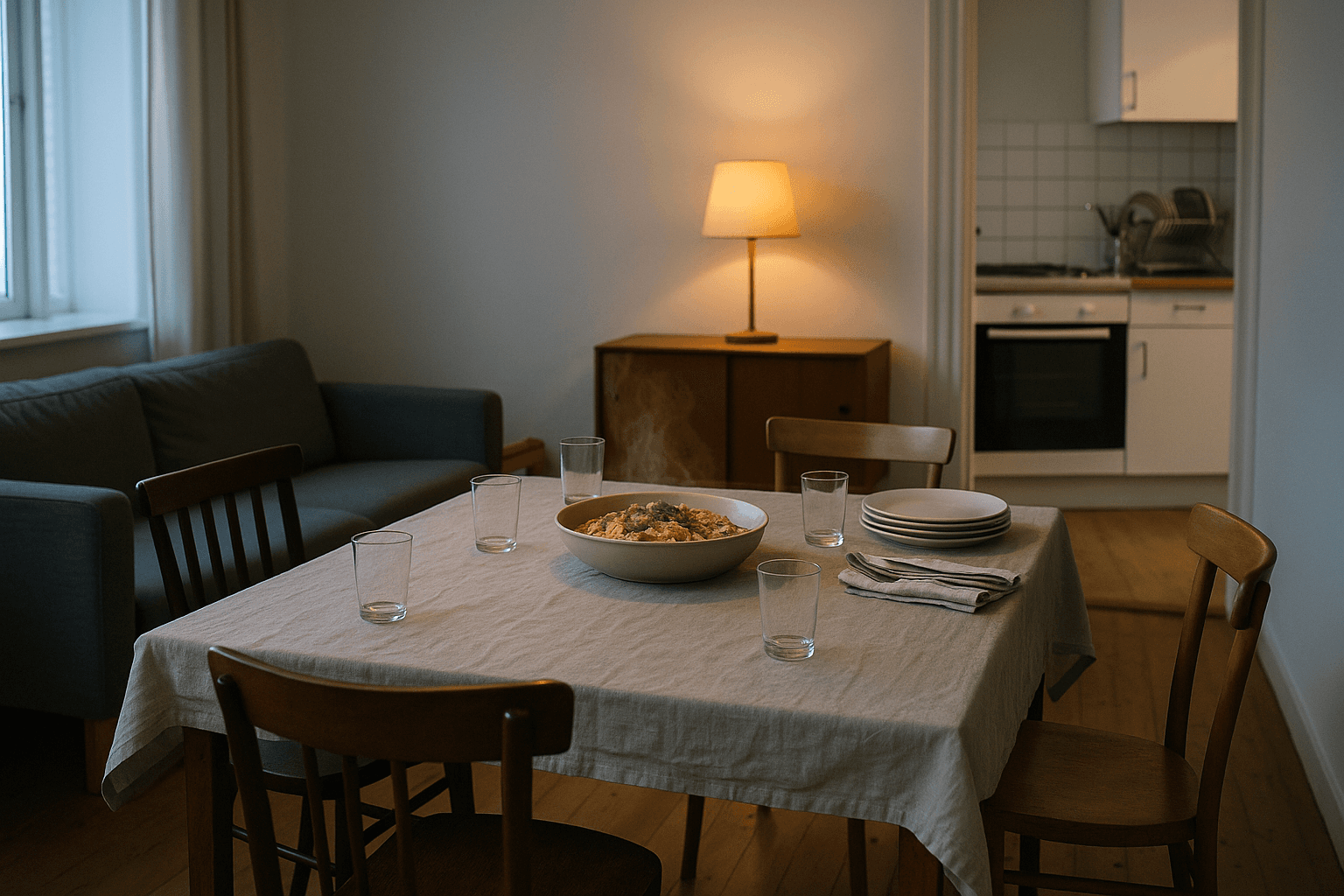
The problem announces itself at about four in the afternoon, when you carry the second chair through from the bedroom and discover that with six chairs around the table, nobody can get to the one nearest the wall without everyone else standing up. This is not a disaster. It is the actual shape of the evening you have agreed to host, and it is better to meet it now than at eight, holding a dish.
Flats without dining rooms are not a hosting problem so much as a sequencing problem. You have one table or no table, one oven, probably four hob rings of which two work properly, and a sink that is also the place where everything has to be put down. None of that stops six people eating well. It just means the decisions get made in a different order than they would in a house with a separate room for it.
Decide where people sit before you decide what to cook
Seating is the constraint everything else bends around, so settle it first, in the room, with the actual furniture. Put out the chairs you intend to use and sit in each one. Cross the room. Get out of the seat by the wall. If it takes a manoeuvre, it will take a manoeuvre six times tonight, and the person you put there will spend the evening apologising for their own legs.
Three practical fixes, in order of how much you want to be moving furniture at seven o'clock.
- Pull the table away from the wall, even if it means the room is now mostly table. A table with access on all four sides seats six comfortably. The same table pushed into a corner seats four and traps two.
- Lose the arms. Armchairs, carvers and anything with a fixed arm eat width and make sitting down a negotiation. Backless benches and stools have the opposite problem — nothing to lean on for three hours — so mix them: solid chairs for the long sides, a stool at each end where people get up more often anyway.
- Seat yourself nearest the kitchen, in the worst chair, on the outside. You are the one standing up all night. Give the good seats away.
Check the chairs themselves rather than assuming. Dining chairs vary enormously in seat width and in how much weight the joints are actually rated for, and the flimsiest ones in any flat are usually the folding spares and the inherited antiques. If a chair creaks when you sit in it, it is not a guest chair. Two sturdy chairs you sit in happily are worth more than four you are quietly worried about, and no host should spend dinner monitoring furniture.
Cook one thing that owns the oven
The classic failure in a small kitchen is a menu where three dishes all want heat at the same temperature at the same time. Build the meal the other way round: one dish takes the oven and keeps it, and everything else is either cold, made in advance, or assembled on the counter while that thing finishes.
Braises, traybakes, whole roasted vegetables, a baked rice or a big gratin all sit in a low oven for an hour without supervision and are more forgiving late than early. That is the quality you want. A dish that is ruined by ten extra minutes is a dish that will be ruined, because somebody will arrive late and somebody else will want to finish their drink.
Around that, the rules are simple. One hob ring at most, and ideally for something that only needs boiling water. Everything green happens raw or dressed. Bread is bought. Pudding is made yesterday, or it is cheese and something in syrup, or it is a bowl of good fruit and a bar of chocolate broken onto a plate, which is a real pudding and stop apologising for it.
Work backwards from when you want to sit down
Pick the time you want people at the table, then count back through everything that has to happen, and write it down. Not a schedule with minutes — a list in order, on paper, somewhere you can see it with wet hands.
- Anything that can be done the day before: pudding, dressings, the braise itself, which is better reheated anyway.
- Anything that can be done by mid-afternoon: table out, chairs placed, glasses down, kitchen cleared, bin emptied.
- Anything in the last hour: the oven dish in, the salad dressed at the end, the bread out.
- Anything after people arrive: nothing, ideally, except lifting one thing out of the oven.
The clearing is the part people skip and then regret. An empty sink and an empty counter at seven is worth more than an extra dish, because the counter is where you will plate up and the sink is where the first round of glasses is going.
Serve from the table, not from the kitchen
In a flat, plating six individual plates means six trips across a room full of chairs. Put the dish on the table and let people help themselves. It is less work, it looks better than it has any right to, and it removes the moment where you are standing at the counter with your back to your own party.
You need a trivet or a folded tea towel, a serving spoon that is genuinely big, and a plan for where the empty dish goes once it is empty, which is the thing nobody thinks about. Clear it to the floor by the wall if you have to. Nobody minds.
The drinks table is not the dinner table
Six people plus six glasses plus six sets of cutlery plus the food is more surface than most small tables have. Put drinks somewhere else entirely — a side table, a chest of drawers, the top of a bookcase near the door — with the bottles, the opener, a jug of water and the glasses on it. People will refill themselves, which they cannot do if everything is trapped behind the dinner.
Same principle with coats. Decide where they go before the doorbell, or they go on the chair you need.
Let the room be small
There is a version of this evening where you try to disguise the flat — move the sofa, hide the drying rack, pretend the kitchen is not four steps from the table. It never works and it costs you the whole afternoon. The better version is to let people see the kitchen, because they were going to, and to accept that somebody will end up sitting on the arm of the sofa with a plate on their knees at some point, and that this is not a failure of hosting. It is what a good evening in a small flat looks like.
Turn the big light off. One lamp and some candles makes a room feel like a decision rather than a compromise, and it hides the drying rack better than moving it would have.
The last thing
Before anyone arrives, fill the kettle and put a clean tea towel over the tap. When you come back at midnight to a sink full of glasses, the kettle is full, the towel is dry, and you can make yourself a cup of tea before you start. That is the whole trick, and it takes eleven seconds.