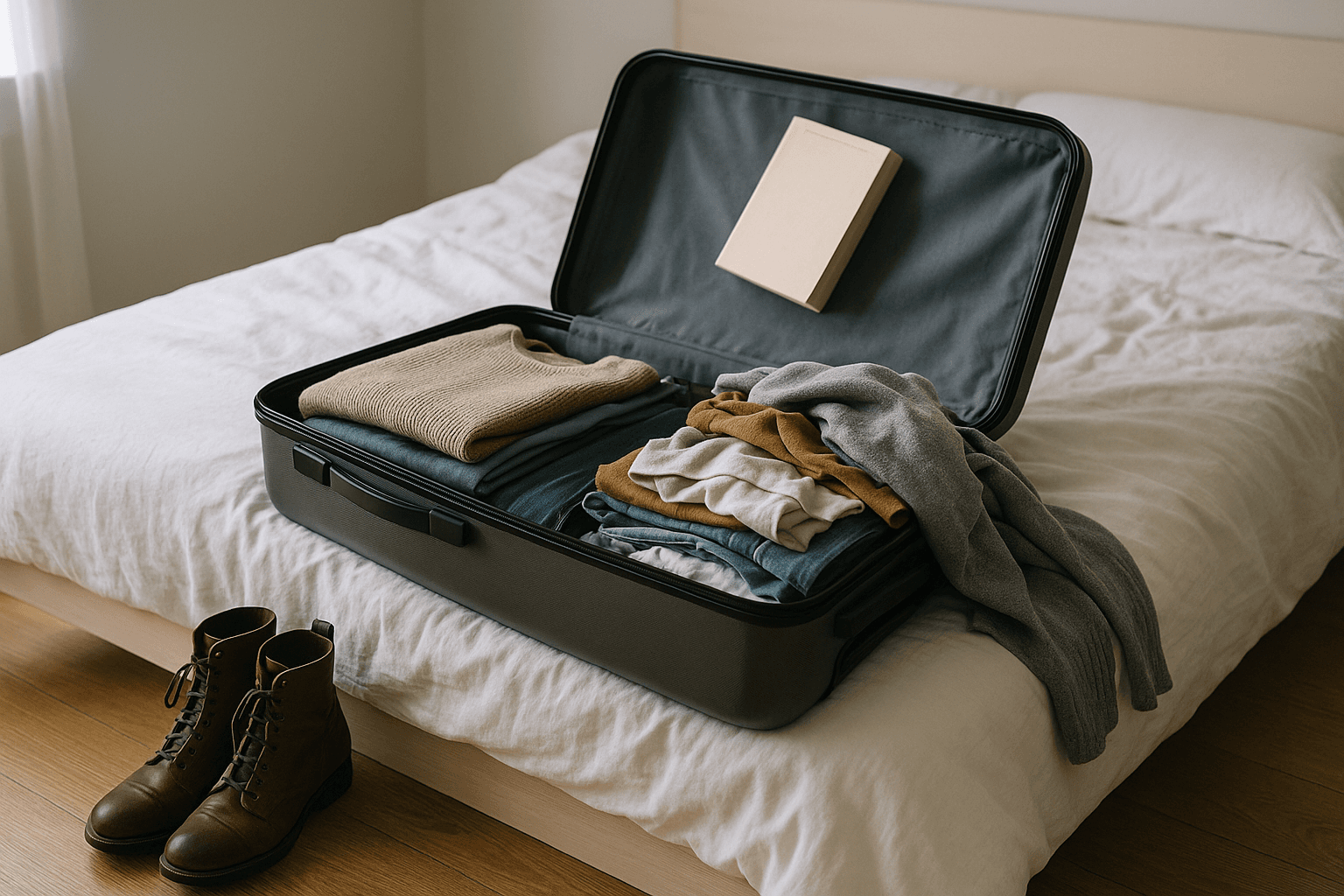
Two nights in a cottage with people I like and the case is full by Thursday. Three weeks later I go away for a fortnight and pack the night before, in the wrong shoes, standing up, from a pile on the bed that I have already sat on twice.
This is not a scheduling problem. The fortnight had more notice, more reason, more consequence. It got less. Everyone I have ever mentioned this to has recognised it instantly, which suggests it is not a personal failing so much as a design fault in the way we imagine the near future.
The short trip is imaginable
A weekend is small enough to picture in full. I can see Saturday. I can see the walk that might happen, the pub that might be cold, the dinner that might be slightly smarter than the rest of it, the morning where someone suggests swimming. Each of those is a scene, and each scene wants an outfit, and because the weekend is short, none of the outfits have to earn their place by being used twice.
So the bag fills with contingencies. Not clothes — contingencies. The jacket for the version of Saturday where it turns. The second pair of shoes for the walk I will not go on. A dress for a dinner nobody has booked. It is fifty-two hours of life and I have packed for about nine separate versions of it.
Two weeks cannot be pictured that way. I can see the first day and I can see the flight and after that it goes soft. There is no Tuesday of the second week in my head, because nobody's head contains that. So I pack for the shape of it instead: hot, mostly outdoors, one thing I could wear to a restaurant. Abstraction is efficient. It just doesn't feel like planning, which is why it happens at eleven at night with the drawer open.
Length does the work you think you're doing
The other thing the long trip has is laundry. Somewhere past about ten days, the arithmetic changes on its own: you will wash something, so you stop packing one of everything per day and start packing a system. Five bottoms, eight tops, the shoes you can actually walk in. The trip is long enough to have a rhythm, and rhythm needs fewer clothes than novelty does.
A weekend has no rhythm. It is all novelty. That is the point of it.
Where the weight actually goes
There is a practical layer under all this and it is worth saying plainly, because the psychology gets more attention than the physics. Fabric has a volume. A structured jacket, a pair of jeans with any weight to them, a coat that is actually a coat — these take the room they take, and if your wardrobe runs to more fabric per garment, the case fills faster than the internet's packing advice assumes. Most of that advice was written by someone rolling three t-shirts and calling it a method.
Which means the case that looks over-packed for a weekend may be correctly packed for the weather and the wrong size for the airline. Those are different problems and only one of them is yours.
The genuinely useful move is the dull one: pack the largest items first and let them set the terms. The coat, the boots, the one heavy thing. Everything soft fills in around them. Doing it the other way round — small things first, structure last — is how you end up kneeling on a lid at midnight, which is a thing I have done and will probably do again.
The person you were going to be
The over-packed weekend bag is mostly an argument about identity, conducted in private, against a deadline. I put the swimming costume in because the version of me who goes away for two nights swims in the morning. I put in the book I have been not-reading for four months because she reads. I put in the good trousers because she has dinner plans on a Friday.
None of this is delusion exactly. It is more like optimism with a zip. The bag is small enough to be aspirational; a fortnight's worth of aspiration would not fit and would cost forty-five pounds extra at the gate.
I am not going to pretend I have cured this. I still take the book. I have made a sort of peace with the book. What I have stopped doing is packing the contingency version of every single day, because a weekend has roughly two real days in it and the other seven were invented in my kitchen on a Thursday.
What survives contact
When I get home from the short trip, the same items are always unworn, and they are always the ones I packed last and fastest, in the final sweep, when I was adding rather than deciding. The dress for the unbooked dinner. The second jumper. The shoes that only work with the trousers I did not bring.
The long trip comes home with almost nothing unworn, because there was never room for anything that wasn't doing a job. Two weeks is honest in a way a weekend isn't. It has too much time in it to be flattered.
The small thing that works
Pack the weekend the way you'd pack the fortnight. Not fewer clothes for the sake of it — the same method. Decide the days that are actually happening, dress those, and then, if there's room, add one thing for the day that might.
And before you close it: take out whatever you put in last. Not on principle. It just isn't going to get worn, and you know that already, standing there, in the wrong shoes.