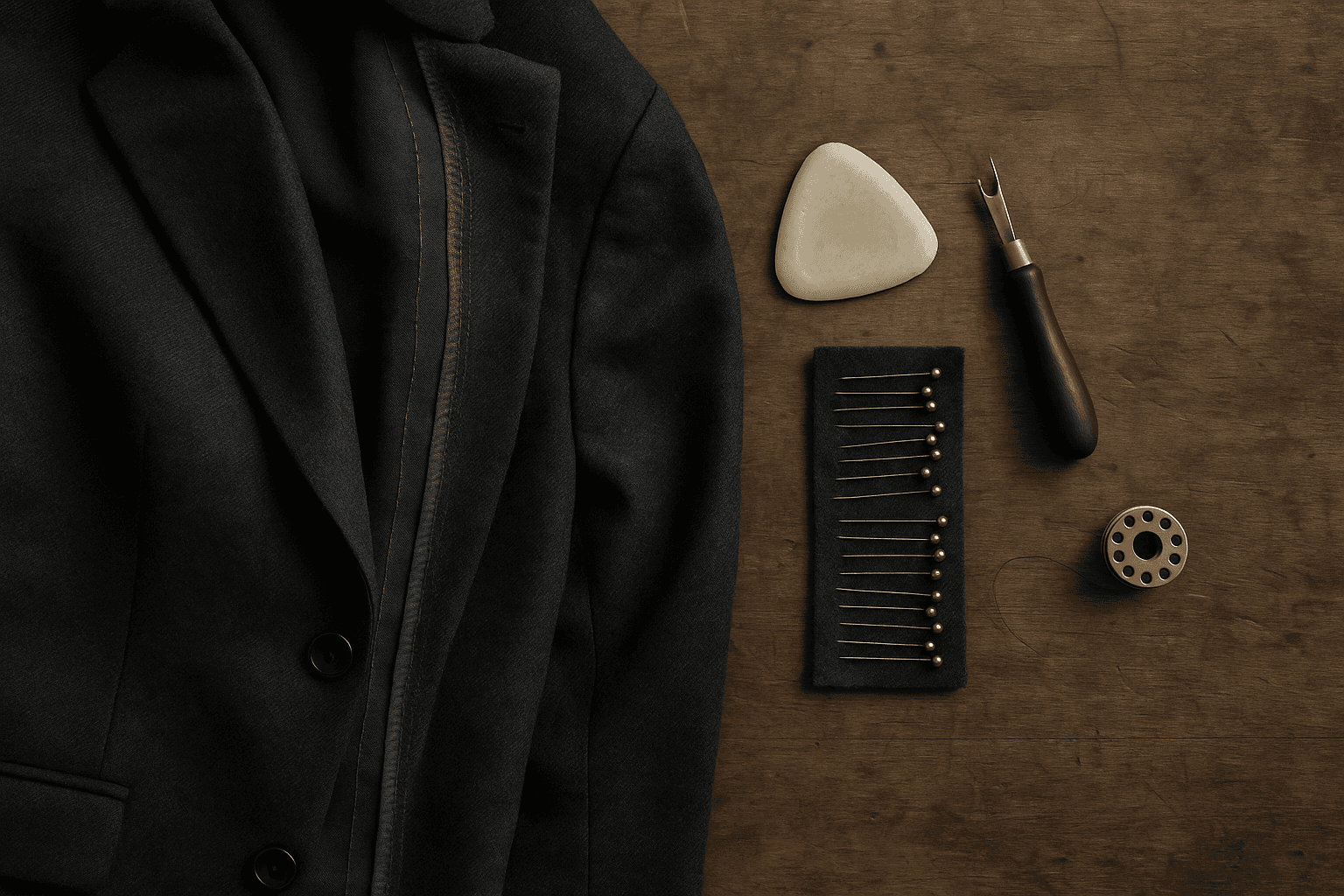
Turn a jacket inside out on the tailor's table and the first thing anyone competent looks at is the seam allowance. Not the label, not the size on the tag. The strip of fabric sitting inboard of the stitch line is the entire budget for every change you are about to ask for, and on a lot of off-the-rack clothing it is about a centimetre of fabric with an overlocked edge chewed into it. There is nothing to let out because there is nothing there.
This is the part of alterations that nobody selling you the garment will explain, and it is the reason two women can walk into the same shop with the same problem — shoulders too wide, waist gaping, sleeve too long — and get completely different answers about what can be done. Alteration is not a service applied to a finished garment from outside. It is an operation on a pattern that already made its decisions, and the larger the size, the more of those decisions were made by arithmetic rather than by a fitting.
Every size in a range is a stretched copy of one size that was actually fitted
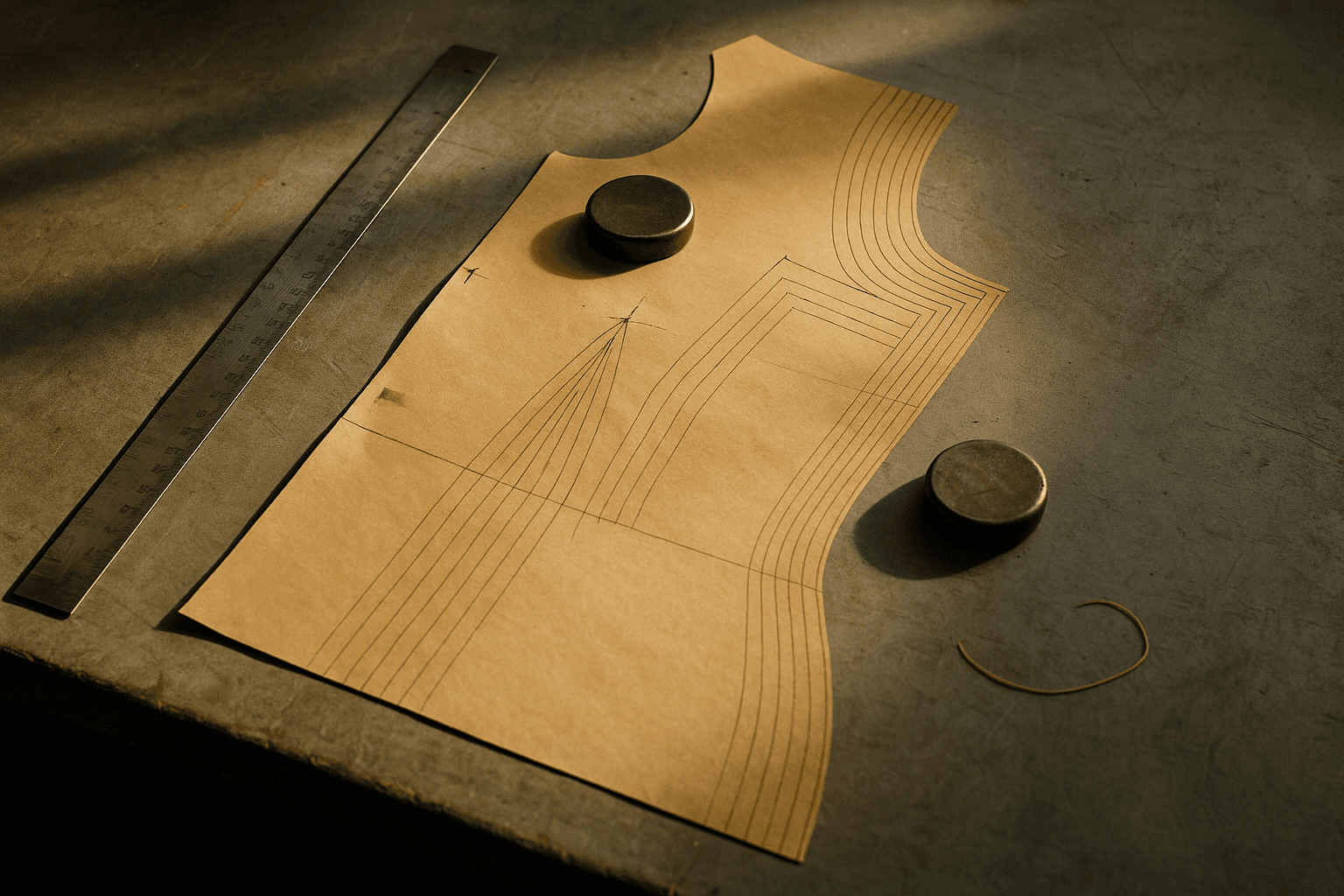
A brand does not draft a pattern for every size it sells. It drafts one — the sample size, the base — and fits it on a live body or a stand. That block gets checked, pinned, corrected, signed off. Then it gets graded: scaled up and down by a set of rules that add or subtract fixed increments at defined points. Chest, waist, hip, across-back, armhole depth, sleeve length, neck. Each point gets its number and the pattern is redrawn outward from the base.
Grading is not a shortcut. It is the standard, legitimate way clothing is made in volume, and a good grade holds shape convincingly across a few sizes either side of the base. What it cannot do is invent information. The further a size sits from the one that was fitted, the more of its shape is extrapolation — a straight-line guess about how a body changes when it gets larger. Bodies do not change in straight lines. They redistribute. Depth increases faster than width in some places, the shoulder slope changes, the distance from the shoulder to the full bust grows, the waist moves in relation to the underarm.
So the practical question in a fitting room is not whether a garment is your size. It is how far your size is from the one the brand actually fitted, and in which direction. A range that stops at 18 and grades up from a 10 is asking the top of its range to be a mathematical projection. A range that grades a separate block for its larger sizes — a second base, fitted on a larger body — will fit differently in the armhole and the shoulder, which is where extrapolated grades fail first.
Taking in is cheap, letting out is a fiction
Removing fabric is nearly always possible. You unpick, restitch inboard of the old line, trim, press, and the garment gets smaller along that seam. The cost is time, and the limit is whether the seam you are moving carries a pocket, a vent, a zip, a lining or a piece of interfacing that then has to be rebuilt around it.
Letting out depends entirely on what is inboard of the stitch line, and on high-volume garments that is usually not much. Factories trim allowances to save fabric and overlock them to stop fraying, which also fixes them in place. Side seams may give you a little. Centre-back seams sometimes give more, because that is where pressing and fitting adjustments were expected. Everywhere else, the honest answer is that the fabric to let out was cut off and thrown away in the factory.
Which is why the standard advice — buy up and have it taken in — is sound advice with a specific expiry date. It works while the next size up is a competent grade of the same shape. It stops working when the next size up is not a bigger version of the garment you wanted but a differently proportioned projection of it, with a deeper armhole, a longer shoulder and a waist in the wrong place. Taking in the side seams of that garment makes it narrower. It does not make it fit.
The armhole is where alteration stops
The scye — the armhole — is the hardest thing on a garment to change and the thing most likely to be wrong at the top of a graded range. As sizes go up, most grading rules deepen the armhole and widen the across-back. Arm circumference does not increase at the same rate as chest circumference, and shoulder width does not increase at anything like the rate of the bust. The result on a projected grade is a scye that is too low, too long front-to-back, and sitting on a shoulder line that has been pushed out past the actual shoulder point.
You feel that as a sleeve that binds when you reach forward, a bodice that pulls across the front when you lift your arm, and a shoulder seam that has slid down the upper arm. None of those are fabric-quantity problems, which is why a tailor cannot fix them by taking in a seam. Raising an armhole means recutting the scye and re-easing the sleeve head into a smaller opening — a new sleeve, in effect, in a garment that may not have enough sleeve-head fabric to spare. Narrowing a shoulder on a set-in sleeve means detaching the sleeve, reshaping the armhole, redrafting the cap, and reassembling with the roll and ease intact. On a lined, structured jacket it is close to remaking the jacket.
Sleeveless and raglan and drop-shoulder garments dodge this entirely, which is one reason so much of the larger end of the market is built that way. It is not laziness. It is a grade that does not have to get the armhole right.
What a bust adjustment actually requires
Most graded ranges add bust circumference without adding much bust depth or moving the apex. On a projected grade the fullest point of the pattern can end up above and inboard of where the body's fullest point actually is, which shows as pulling at the side seam, a hem that rides up at the front and a neckline that stands away.
Fixing that properly means opening the front, adding depth through a dart or a princess seam, and re-truing the side seam and hem. On a garment cut with a princess line or existing shaping, there is somewhere to put the change. On a front cut in one flat piece with no dart, there is no structural place for depth to go, and a tailor asked to solve it with the side seams will simply remove width from a garment whose problem was never width. Get the front-piece question answered before you buy: if there is no dart and no princess seam and the garment is not knit, the shaping you need does not exist in it.
What to check before you pay for anything
- Turn the side seam allowance out at the hem and look at the width of fabric inboard of the stitching. That is your entire letting-out budget, and an overlocked edge usually means it is the whole story.
- Find the shoulder seam and locate your actual shoulder point with your fingers. If the seam sits past it, you are looking at a sleeve removal, not an adjustment.
- Lift both arms straight forward. Binding and pulling here is an armhole problem, and armhole problems are the expensive ones.
- Look at the front piece. Dart, princess seam, or nothing. If nothing, there is no route to bust depth on a woven garment.
- Check whether the seam you want moved carries a pocket, a zip, a vent or interfacing, because each of those is rebuilt labour on top of the alteration.
- Note where the waist shaping sits relative to your own waist. Length through the body is not something side seams can give you.
The useful conversation with a tailor is not "can you make this fit" but "which of these three things is cheapest to change and which is impossible." A good one will answer in about ninety seconds and will tell you to put the garment back.
And when a brand tells you its clothes are designed for your size, ask which size it fitted. The answer is a number, it is usually the smallest one, and nobody has ever volunteered it.