Three swimsuits, same size on the label, all ordered the same evening because the size chart said they were equivalent. One cuts across the top of the thigh and rides up within a step. One has a bust cup that would fit a different person entirely. The third fits, and it fits so well that you will want another in every colour, which is the moment you learn it was a one-season buy and will not be repeated. Nothing has gone wrong here. The three suits were never the same garment.
Swimwear is the least forgiving category in a shop because it has no ease. A dress can be cut generously and read as a choice; a jacket can be graded badly and the shoulder pads will hide it. A swimsuit is a stretch garment sitting directly on the body with negative ease, which means it is cut smaller than the body it is meant for and relies on the fabric's recovery to close the gap. Every decision made in the pattern room is therefore visible on the wearer. So is every decision made about whose body the pattern was based on.
A size is a position on a grade, not a measurement
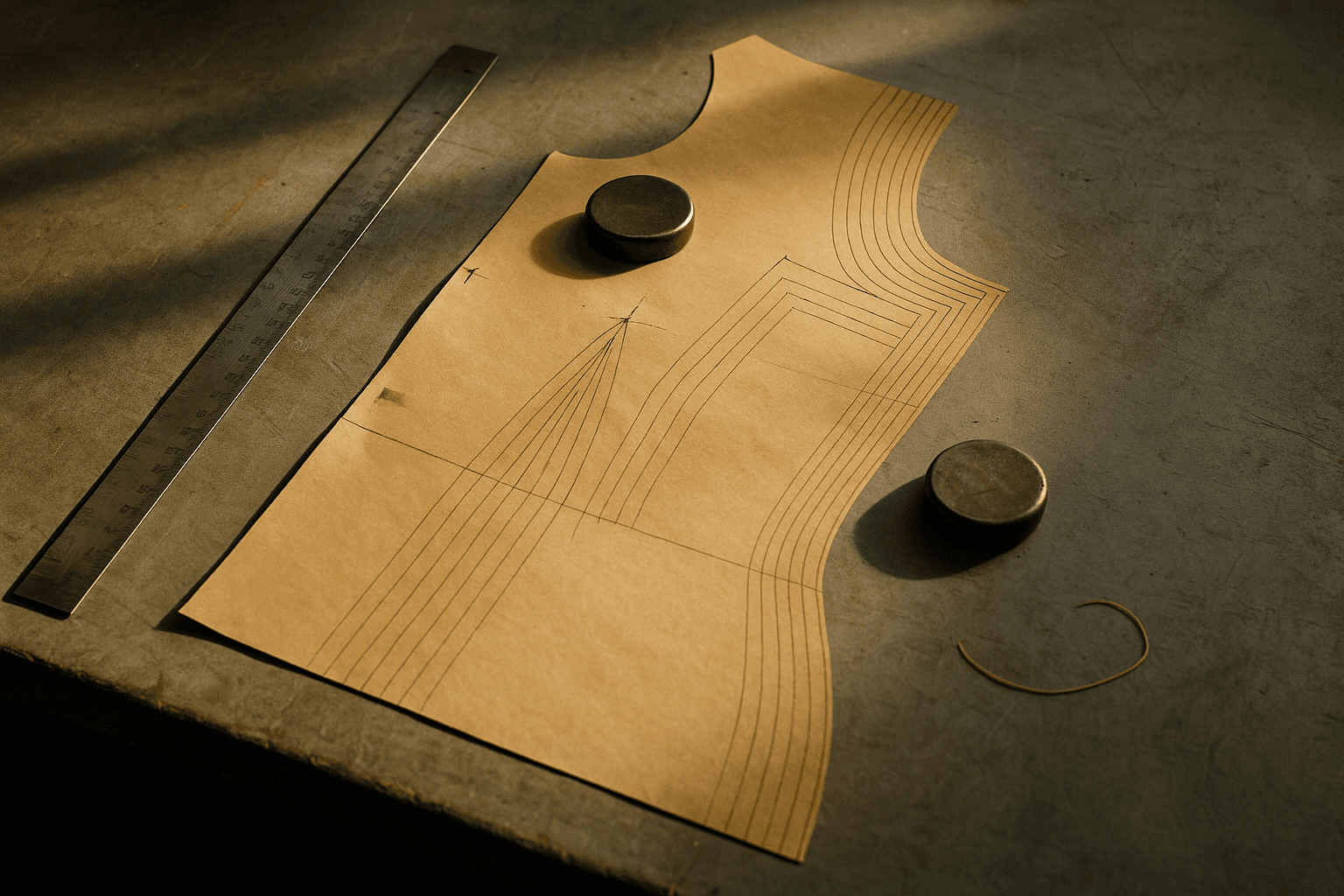
Retailers build from a fit block: a base pattern developed on one fit model, or on a set of measurements a buying team has agreed represents its customer. That block is the truth of the range. Everything else is arrived at by grading — adding and subtracting increments across the pattern to produce the sizes on either side.
Two things vary between retailers, and both matter more than the number on the label. The first is where the block sits: a range that begins at 16 or 18 has usually been graded up from a base size somewhere in the middle of the straight-size range, which means the larger end of it is a long way from the body it was developed on. A range designed from its own block, developed on a fit model within the range, behaves differently at the top end because the extrapolation is shorter. The second is the grade rule itself — how much is added per size, and where. Add evenly all round and you get a garment that grows in every direction at once, including the directions nobody asked for: longer through the body, wider at the shoulder, deeper in the armhole.
This is why one shop's 20 is short in the body and another's is long enough to sit properly at the shoulder, and why the same customer can be two sizes apart in two suits that both claim to fit a 46-inch hip. The chart describes an intended body. The garment describes a grade.
What to check before you get as far as the size
Most of what determines whether a swimsuit will work is legible from the product page and the garment itself, before the question of size is settled. Work through it in this order.
- The fabric content. Look for the elastane percentage — the higher it is, roughly, the more the fabric will stretch and recover. Low elastane in a garment with negative ease is how you get a suit that fits in the changing room and has slackened by the second wear.
- The lining. A fully lined body, front and back, does structural work: it holds shape, controls the fabric, and stops the print going translucent under tension. Front-lining only is a cost decision, and it shows at the seat and the side seam.
- The bust construction. Three broad approaches: a shelf bra or internal band, moulded cups, or nothing but a lining and a shirred panel. A shelf bra with a band that closes is the only one of the three that is doing anything for a larger bust. Moulded cups are set at a fixed distance apart on the pattern and do not move as the size grades, so if your bust points sit wider than the cups, the size above will not fix it.
- Strap width and attachment. Where the straps meet the front of the suit tells you what weight the pattern expects them to carry. Narrow straps set close to the neck concentrate load; wider straps set further out spread it and stay put.
- The leg line and the rise. A high leg cut into a short body is the mechanism behind almost every suit that rides up. Look at how much depth there is between the crotch seam and the top of the leg opening, not just at how high the leg looks on the model.
- The back. A low scooped back removes the structure that holds the front up. It is a styling choice with consequences, and the consequences arrive when you stand up out of the water.
The size chart is a document with a purpose
Size charts are written to reduce returns, not to describe garments. They give body measurements, which is a different thing from garment measurements, and the difference between the two is the ease the retailer has decided to build in. For swimwear that difference is negative, and no chart tells you by how much. A retailer that publishes garment measurements — flat width across the bust, garment length from shoulder to crotch seam — is giving you something you can act on. Most do not.
Where measurements are missing, the review photographs are the better source. Not the star ratings. What you want is customer images showing the suit on a body at your end of the range, and specifically the back view, because that is where a poor grade shows first: strap dig, a band riding up, gathering at the side seam where the pattern ran out of width.
Learn the retailer, not the number
The practical shortcut is to stop treating size as portable and start keeping notes on shops. One retailer runs short in the body. One grades the bust generously and the hip not at all. One has a good block up to a point and then loses it. That information is worth more than any measurement you have, because it is specific to how those garments are actually built, and it stays true for as long as the block does.
Blocks do change. A range that has fitted you reliably for years can shift when a supplier changes, a buying team is restructured, or the fit model is replaced. The tell is usually subtle and always the same: the suits you already own no longer match the new ones in the same size. When that happens, the old information is gone and you are starting again.
Where the range stops tells you what the block was
A retailer whose swimwear stops at 18 while its dresses run to 24 has not made a stock decision. It has made a pattern decision. Swimwear at the larger end needs a different bust construction, more lining, more support components and a block that can carry them, and all of that costs development money against a category with a short selling season and a high return rate. Stopping is cheaper.
The same logic governs what happens inside a range that does go up. The top two or three sizes are frequently the least developed, because they are the furthest from the base and the last to be fitted, if they are fitted at all. Some ranges are sampled in the base size and graded straight out. You can feel it: the proportions stop making sense in a way that has nothing to do with your body.
What to do in the fitting room
Put it on and then behave like a person rather than a photograph. Raise both arms fully. Sit down. Bend forward from the hip. Walk four steps. Reach behind your head as if fastening your hair.
You are testing three things: whether the straps stay where they were put, whether the leg opening returns to where it started, and whether the front stays up when the back is loaded. If the suit fails any of these in a fitting room, it will fail harder wet, because water adds weight and chlorine degrades elastane. A suit that only just works dry does not work.
Buy the one that passes and write down the retailer, the style name and the size. That note is the only sizing system that will hold.