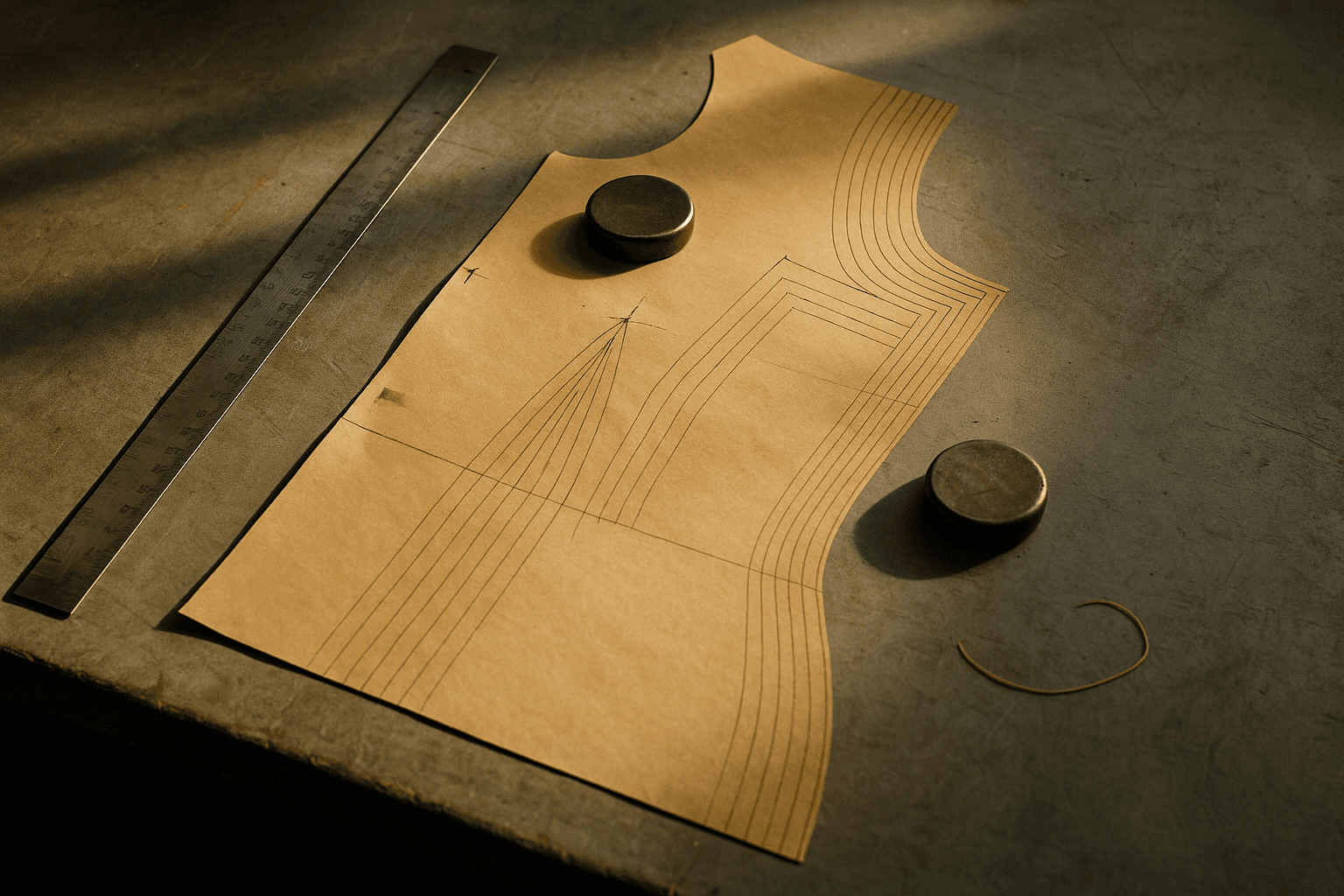
The capsule wardrobe fails on a Tuesday, at about ten past seven, when the one pair of trousers that works is in the wash and the other pair is not a substitute for it, because it was never the same trousers in a different colour. It was just the only other pair you could get.
That is the whole problem with the formula, and it has nothing to do with discipline. The 33-item capsule — or the 30, or the 37, the number moves around depending on who is selling the idea — is a maths problem that assumes interchangeable parts. Three tops that all work with two bottoms, so six outfits. Add a third bottom, get nine. The arithmetic only holds if the parts genuinely interchange, and that requires the thing a smaller shopper has without noticing: several versions of the same garment, in different fabrics, at different prices, from different shops, available now.
Above a certain size that depth is not there. You do not have three straight-leg trousers to choose between; you have the one that fits and a maybe. So you cannot build a system of substitutions. You have to build something else, and the something else is not a smaller number of better things. It is a different structure.
What the formula is actually doing
Strip the moralising off a capsule wardrobe and it is doing three jobs. It reduces decisions in the morning. It stops you owning four coats and no jumper. And it forces every purchase to justify itself against what you already have.
All three are worth having. Only the first one depends on retailer depth, and it is the one everybody copies. The morning-decision job is what makes people evangelical about capsules — the grid of interchangeable pieces, the fact that anything goes with anything. That grid is downstream of a market where you can buy the same shape twice.
So keep the auditing and the gap-spotting. Give up on the grid. Replace it with outfits.
Build in outfits, not items
An item wardrobe is a set of parts you assemble each morning. An outfit wardrobe is a set of finished answers you already know work, which you assembled once, standing in front of a mirror with time to spare.
Count outfits, not garments. Eight complete outfits that cover your actual week is a functioning wardrobe even if it contains thirty-one things and three of them do nothing except make one outfit work. That silk-ish shell that only goes under the one blazer is not a failure of the system. It is a component.
The practical version: work out how many genuinely different situations your week contains. Most people have four or five. Work, work-but-seen-by-people, home, cold outdoors, and something in the evening. Assign outfits to situations, in twos where you can, because everything needs a wash.
Duplicate, and stop apologising for it
The capsule literature is hostile to owning the same thing twice. It treats duplication as a failure of imagination. In a thin market, duplication is the only real insurance you can buy.
When something fits properly — not acceptably, properly — buy it again. Two of the same trouser in the same colour is not boring; it is the difference between having trousers and having trousers if the laundry cooperates. The reason this feels indulgent is that the advice was written for people who can replace a garment at will in eight weeks' time. If your size disappears from a line before the season ends, replacement is not a plan.
Worth noting what you are actually insuring against. Not wear — most things outlast their availability. You are insuring against a brand changing its grading, discontinuing the top of its range, or quietly reissuing the same style with a different block.
Learn the three cuts that decide everything
If you can only assess a few things in a fitting room, assess these, because they are where a garment was graded for somebody else.
The armhole
On a badly graded garment the armhole gets deeper and wider as the size goes up, because the pattern was scaled outwards rather than re-cut. A low, wide armhole means you cannot raise your arms without the whole body of the garment lifting. Test it by reaching forward for something, not by standing still. If the hem travels, the armhole is doing it.
The shoulder seam
Look for where the seam sits relative to the end of your shoulder. Grading that adds width everywhere pushes the shoulder seam out past the joint, which reads as a jacket slightly too big even when the body fits. A shoulder that sits correctly will make an otherwise mediocre garment look bought on purpose.
The rise and the waistband
Most trouser disappointment is a rise problem dressed up as a size problem. If the waistband gaps at the back and digs at the front, the rise is short for you and no amount of sizing up fixes it; you get more circumference and the same rise. Sitting down in the fitting room is not optional. Stand up again and check whether the waistband has stayed where you left it.
Buy for the outfit you are short of
The gap-spotting part of the capsule method survives intact, and it is the most useful thing in it. Before buying, name the outfit the garment completes. Not the vibe — the outfit, with the other items in it, all of which you own.
If you cannot name it, you are buying a hypothetical. Hypotheticals are how people end up with a wardrobe that is 60 per cent tops. Tops are the easiest thing to buy above a size 18 and therefore the thing you accumulate by default, which means the missing pieces are almost always the structural ones: the jacket, the trouser, the skirt that is not jersey.
Keep a list of the blocks that work
Not brands — brands change. Blocks. Write down the specific garment, the size, the fit name if it has one, and one note about why it worked: high rise, set-in sleeve, not too much ease through the upper arm. Over a year this becomes more useful than any amount of general advice, because it is a record of who grades for a body like yours.
It also makes online ordering tolerable. When a measurement chart is the only information available, having your own list of what a working rise measures in centimetres turns a guess into a comparison.
What to do this week
Go and look at what you wore in the last seven days. Not what you own — what you actually put on. Those are your real outfits, and there are probably fewer of them than you think.
Then pick the one you wore most and check whether you own a second version of any part of it. If you do not, that is the next thing to buy, and you already know it fits.